


“Serious sport has nothing to do with fair play. It is bound up with hatred, jealousy, boastfulness, disregard of all rules and sadistic pleasure in witnessing violence: in other words it is war minus the shooting.”
George Orwell, The Sporting Spirit (1945)
Introduction
Among the casualties of the Second World War were two World Cup competitions. The FIFA World Cup had only taken place three times before the war broke out: in 1930, 1934, and 1938. It didn’t happen again until 1950. Speculation about what the missing World Cups might have looked like, and, perhaps more importantly, who would have lifted the coveted trophy, will always have appeal. But we can do better than idle guesswork.
For research purposes, Aleph Insights has developed a Bayesian hierarchical model that predicts - or, more accurately, assigns probabilities to - the outcomes of football matches. Known as ‘Predictotron’, this model assumes that teams have various hidden qualities that can change over time, and about which we can only make inferences based on observed match results. As a side-effect of developing this model, we now have a way of forecasting the outcomes of football matches between any teams, from any era, at any time. Evaluations of its forecasts suggest that it is comparable in performance (although, sadly, not systematically superior) to the forecasts implicit in betting market odds. The model enables us to take a data-enabled approach to counterfactual history, which means we can reconstruct a fictitious 1942 World Cup in a statistically-robust manner.
The rest of this post outlines the approach we took to conduct this speculative historical exercise. In subsequent posts we’ll describe the scenario, outline the teams, and deliver round-by-round results and analysis from the 1942 World Cup.
Development Process
To reconstruct a speculative 1942 World Cup, Aleph used a mixed-methods approach, combining backcasting, qualitative research, and statistical modelling. The methods used are outlined in the table below.
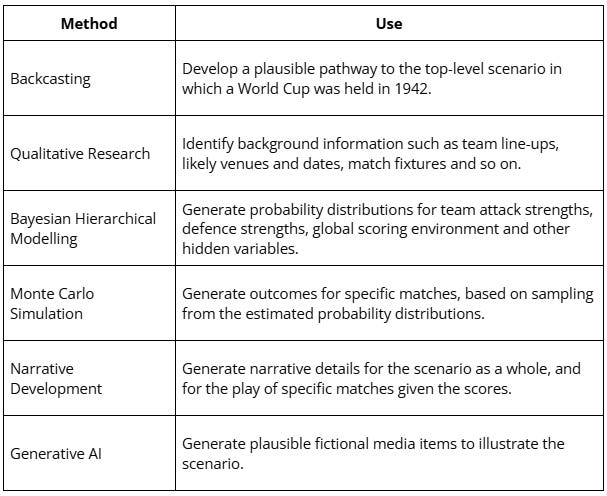
The rest of this section outlines the process used to generate the 1942 World Cup story that will be presented in the next few posts.
Historical Background
In order for the 1942 World Cup scenario to be plausible, it needed to accommodate as much historical reality as possible, which in practice meant dealing with the thorny issue of World War Two.
In many ways the Spring of 1942 was a moment of balance in the Second World War. Germany had occupied much of Western Europe, and the Nazi advances into the Soviet Union had not yet reached their high tide. In the Spring of 1942 Japanese forces captured Rangoon, expelling the British and their allies and severing a vital link between Britain and the jewel of its Empire. While many historians argue that the antecedents of Allied victory were already sown at this point, the Americans were yet to flex their muscles at the Battle of Midway, the Russians were yet to repel the Germans from the banks of the Volga, and Monty was yet to send Rommel back to the pavilion for an early tea. In short, the beginning of the end had not yet begun. It would have been easy at the time to have assessed that momentum was with the Axis powers, without realising this was in fact the moment of their zenith.
While many countries had already sided with the Allies at this point, some governments for reasons of history or politics were still sympathetic to the fascists’ cause, and hedged their diplomatic bets. Nazi diplomacy, espionage and propaganda sought to portray an image of German success and Allied failure. Occupied and collaborationist governments, as well as neutral nations, were encouraged to support the Nazi war effort, or at least not express support for the Allies. In particular, Francoist Spain’s ideology and strategic geographic position made it an important target of diplomatic effort for Germany.
Most international sporting competitions had been halted following the outbreak of war in Europe. However, elite sporting competition continued in various adapted forms as a means of maintaining the morale of populations suffering from the anxieties and privations of war. ‘Home Nations’ football matches between the United Kingdom’s constituent nations continued in some form throughout the war, and domestic competition was sustained through regional leagues (with a maximum travelling distance limit) and the Football League War Cup.
Throughout 1940 and 1941, Nazi Germany continued to play international friendly football fixtures against countries such as Hungary, Italy, Romania, Finland and Switzerland. For many years, sport had been an important propaganda tool for the Nazis, and - where practicable - this continued to be the case during the early war years. The German film, Das große Spiel (The Great Game), featuring a centre-forward involved in a complicated love triangle, was released in 1942 and became a box office success. In April 1942, Spain drew 1-1 with Germany in a propaganda match held in Berlin. Attended by over 90,000 spectators, it was specifically used to honour the División Azul (Blue Division) - Spanish volunteers fighting alongside the Wehrmacht on the Eastern Front.
Scenario Development
Our scenario is set within this broader historical context. We have sought to alter as few ‘real’ parameters as possible. The prevailing conditions during the Second World War have been maintained, and the implications of these conditions for international sporting competition form the backdrop for the fictional details of the scenario. The scenario seeks to be consistent with a number of historical factors, which include:
International Relations - The extent to which relations between nations would have deterred them or encouraged them from participating in sporting competitions with one another during this period.
Sporting Activity - The level of participation of different nations within international sporting competition in general, and football in particular, and the status of organising bodies such as FIFA.
Conflict Geography and Logistics - The effects of the conflict on different countries and the disruption of national infrastructures and international travel.
Politics and Key Individuals - The existence of the underlying motivations to consider hosting a tournament, and the will and capability of governments and individuals to fund, participate in or host a World Cup.
The first significant decision that was taken regarding the scenario was which nations would take part. We considered it implausible in the context of the Second World War that any nation regardless of their wartime allegiances would consider taking part. Allied powers (such as Britain and Russia) had ceased taking part in international sport in the war years. Furthermore, although the Home Nations (England, Scotland, Wales and Northern Ireland) played football fixtures amongst themselves during the war, they did not participate in the qualification process for a World Cup until the 1950 tournament. Germany and other Axis partners, in contrast, continued to take part in international football matches up until 1942. We therefore decided to make the World Cup an Axis-dominated tournament. Only countries which were either occupied (and therefore coerced), neutral, sympathetic to the Axis, or formally allied with it were considered as participants. It was considered unlikely that FIFA (which had its own organisational and financial issues during the war) would have endorsed the tournament, so we decided to make the tournament ‘unofficial’ from the perspective of the governing body.
The structure of previous World Cups had been built around 16 participants and a knockout format. We opted for the same competition structure and included the following teams (also taking into account the requirement for participating nations to have some level of domestic footballing culture and history): Germany (including Austria), Spain, Italy, Hungary, Switzerland, Bulgaria, the Slovak Republic, Croatia (the NDH), France (Vichy France), Finland, Denmark, Sweden, Romania, Argentina, Chile and Portugal.
Spain was chosen as the venue for the tournament having taken into account which countries might have had a secure enough environment and the footballing infrastructure to host the tournament. Germany was an obvious potential choice, but the logistics of getting participating teams into Germany and the risk posted by strategic area bombing precluded this option. Spain’s official non-belligerent status made it less hazardous as well as enabling the safe passage of teams via Spanish-flagged shipping from South America. The hosting of the tournament by Spain (rather than Germany) would also have made it easier for non-Axis nations to take part without significantly damaging diplomatic relationships with the Allies.
We determined that the logistical organisation of a World Cup during these testing times would be shared between Germany and Spain. The Nazi regime might have plausibly invested (diplomatically, financially and in terms of transport logistics) in the tournament in order to seek to bolster German national morale, demonstrate Germany’s ascendancy at a pivotal point in the war, and cement Nazi diplomatic relationships with sympathetic nations. This latter aim could have been particularly key in the context of German-Spanish relations, with the hope being that it might help to boost recruitment for Spain’s anti-communist Blue Division, which was fighting on the Eastern Front. A real friendly football fixture between Germany and Spain was held in April of 1942 with this purpose in mind, and so in a sense this scenario represents an expanded version of this sporting event.
Franco’s regime, in turn, could conceivably have thought that the event would help to showcase Spain’s modernity and promote a much-needed sense of national unity, following the ruptures of the Civil War. These various motivations and the use of real historical figures were used to provide the specific points of detail, which not only bring a scenario to life, but also help to consider systematically what might have happened. These social and human factors, for example, led to the decision to create a draw that was rigged to favour both Germany and Spain. Hitler was reported to have been furious when the German national football team lost a fixture to Switzerland in 1941 on his birthday, and it seems likely that the Germans and Spanish could have taken measures to improve the probability of their teams progressing in the tournament given their investments in its organisation.
Model Development
The narrative scenario was used to establish the overarching parameters for the tournament: the teams that would take part, the rules, and the tournament structure. The generation of the results, however, was delegated to a specially-trained statistical model called ‘Predictotron’.
Predictotron is a Bayesian hierarchical model (BHM) which assumes that, in any given football match, goals are scored according to a Poisson process. This is a fairly standard assumption in modelling sparse events like goals, which can happen at any time (rather than at set intervals), and is commonly used in modelling the results of sports like football. Predictotron assumes that the average scoring rate is a combination of one team’s attack strength, and the opposing team’s defence strength, and some other parameters such as the stage of the match (i.e. first half, second half, extra time).
Predictotron has to address several methodological challenges with this kind of modelling. First and foremost, football is a very noisy way of sampling the strengths of different teams, due to its low score rate. A score of 0-0 is common in football, but is rare in rugby, and is vanishingly unusual in cricket, basketball, or American football. This means that, compared to higher-scoring sports, you do not get a particularly good signal about relative strength by observing any one match.
Second, there is a problem of ‘identifiability’: in any sport, you don’t actually sample the strength of Team A, only the strength of ‘Team A versus Team B’, and a high score in a given game might be due to Team A being strong or Team B being weak (or indeed that Team A just got lucky). Compounding these uncertainties is the fact that these hidden features obviously change over time, so that although Brazil’s performance in 2026 is somewhat informative about the quality of Brazil in 2022, it tells you much less about their capability in 1970.
The BHM approach accepts all of these difficulties, albeit at a computational cost. Unlike many standard modelling approaches (such as those based on maximum-likelihood estimation) that only seek to identify a ‘most likely’ value, or ‘estimator’, for unknown variables, a BHM retains uncertainty about unknowns in the form of implicit probability distributions whose shape is ultimately conditioned by the available data and specification of the model. BHMs can be slow to train, and are complex to query; derived features such as the shapes of the posterior probability distributions need to be explicitly calculated rather than simply falling algebraically out of the training process.
In the case of Predictotron, however, we considered that using a BHM was essential in order to accurately capture uncertainties about team strengths for forecasting purposes. Simulations based only on most likely values for team abilities would produce misleadingly predictable-looking results. The Bayesian approach sometimes generates weird-looking outcomes (e.g. a particular ‘possible world’ sampled might have Panama on a par with Brazil), but if the model is well-specified, the probability of drawing a weird possible world in any given simulation is equal to the (low) probability of it in fact being the truth.
Aleph implemented Predictotron using the PyMC Python library, and trained it on data collected and made available by Joshua Fjestul (Fjelstul, Joshua C. “The Fjelstul World Cup Database v.1.2.0.“ July 19, 2023. https://www.github.com/jfjelstul/worldcup). This data only covers World Cup competitions themselves, and does not include qualifiers or other internationals played at different times. This means the model is not as informed as it might be, but we considered this a price worth paying, given the quality and ready availability of the dataset, and the fact that the project is not after all a commercial one but mainly for fun.
Modelling Assumptions
The 1942 World Cup scenario presented a range of questions about how different teams should be handled from a modelling perspective. These related, first, to how national teams should be modelled when their nation wasn’t (for various reasons) representative of the historical data either side of the Second World War, and, second, to how we should handle countries that do not have representation in the dataset until much later. Broadly, we adopted two fairly blunt approaches, favouring reasonableness and transparency, and which avoided imposing too much statistical micromanagement and historical guesswork.
The first was to use proxies for missing, or historically-anomalous, countries that are approximately the same country as another one appearing in the dataset (i.e. in 1938 or earlier, or in 1950 or later). For example, we treated the Germany of 1942 as the same entity as the Germany of 1938, and the West Germany of 1950 onwards, despite the fact that these are not quite the same thing as each other, and both are distinct from the combined Germany and Austria that are competing as ‘Germany’ in our scenario.
This means that the performance of our hypothetical 1942-Germany is informed by the performance of 1938-Germany, as well as by 1950-West Germany, making the results somewhat more accurate than ignoring these altogether. Using similar logic, we treated 1942-France as the same entity as past and future France, despite its unusual wartime status, we proxied Slovakia with Czechoslovakia, and we used Yugoslavia to represent Croatia.
However, for nations that do not have historically-plausible proxies, or which only appear in the data much later on, we took an approach that amounted to saying “we have no idea how good or bad this team is”, and simulated the strengths of those teams from a distribution that is representative of a prevailing ‘average’ international football team. We took this approach for Denmark, who did not play in a World Cup until 1958, Bulgaria (1962), Portugal (1966), and Finland who - it may surprise some readers - have never qualified for a World Cup competition and who therefore are unrepresented in our dataset.
Simulation
The approach taken to simulate outcomes was not one that you would normally use for statistical modelling. Typically, the purpose of simulating a World Cup would be to identify probabilities of different outcomes (e.g. the results of specific matches, or the winner of the tournament as a whole) through analysing the frequency distribution produced by the model. For a given run of the simulation, the ‘hidden values’ (i.e. team strengths and other parameters) are drawn from the posterior probability distribution implied by the model. Then, these values are used to generate results using a Monte Carlo simulation based on the assumed Poisson distribution data-generating process. Typically, you would want to run a reasonably large number of simulations, so that the frequency of simulated results more closely approximates the probability mass function for those results actually occurring.
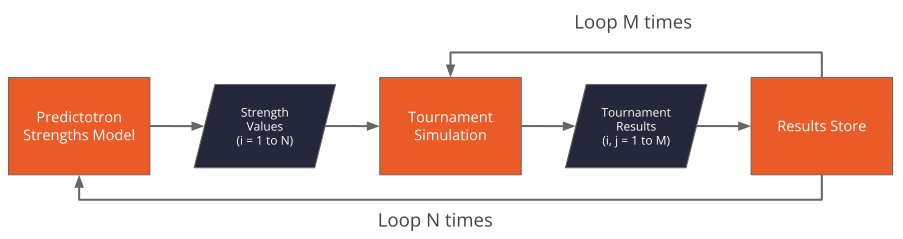
However, we didn’t want our simulated 1942 World Cup to be some kind of ‘average’ outcome. In real life, weird stuff happens all the time. Massaging the simulation so that the results looked more ‘plausible’ would actually make it less realistic. If the Predictotron model is a reasonable approximation of reality, the probability of drawing a ‘weird possible world’ would be the same as the probability that that weird possible world was in fact the one that actually happened. This is exactly what we wanted, so in our case we chose to draw one set of hidden values, and then simulate exactly one 1942 World Cup. As with the 1938 World Cup, draws at full time are decided by extra time, while draws at extra time are broken by a simulated replay of the entire game.
In the next post, we’ll present the 1942 World Cup Scenario, and cover the run-up to the competition, the teams, and the venues.